en
Engineering for continuous innovation
Harnessing technical excellence and digital technology to support projects
Setec TPI’s expertise is demonstrated first and foremost by its ability to tackle projects involving significant technical challenges by offering solutions that are innovative, reliable, robust and safe. It is focused on the success of demanding projects, with a view to ensuring their performance and sustainability.
To stay ahead of technical, regulatory and environmental developments, setec tpi invests around €2 million a year in research and development, representing nearly 3 per cent of its turnover.
Our approach is based on three complementary commitments:
In-house tools designed to enhance performance and accuracy
Our current work forms part of a long tradition of research and development on which setec tpi has relied since its inception. From punch cards to GPU-based calculations, setec tpi has kept pace with and integrated the technological advances that have gradually digitised our fields of expertise.
Our in-house calculation software, a legacy of generations of passionate engineers, is still actively used, maintained and developed. It is constantly evolving to respond to changes in the profession — new materials, repair techniques, complex geometries — as well as to advances in computing power and the regulatory framework.
Business ecosystem: learn, contribute, share
Expertise cannot be imposed; it must be nurtured and continually developed. With this in mind, setec tpi is actively involved in its professional community in order to remain at the cutting edge, share its experience and contribute to the training of the engineers of tomorrow.
Staff are therefore encouraged to participate:
- in working groups, notably within the French Civil Engineering Association and the French Association for Tunnels and Underground Space;
- in research projects, such as the national CEOS and DOLMEN projects, as well as the timber sector initiative led by AdivBois;
- in conferences, congresses and leading publications in the sector, both in France and internationally, notably with the International Association for Bridge and Structural Engineering, the Council on Tall Buildings and Urban Habitat, and the International Wood Construction Forum, as well as professional events such as the Urban Projects Forum or BIM World;
- teaching initiatives at leading engineering schools, notably the École nationale des ponts et chaussées, the Centre des hautes études de la construction, the École spéciale des travaux publics and the École des ingénieurs de la Ville de Paris.
In addition to these initiatives, setec tpi invests in the continuous professional development of its staff throughout their careers. An in-house university, open to all, offers more than 30 sessions each year, helping to foster curiosity and technical knowledge amongst the teams.
BIM, digital twins, data, AI: practical solutions to support projects
At setec tpi, innovation is first and foremost at the service of our projects. Initiatives led by our operational teams are nurtured within a structured and managed framework. They all aim to push the boundaries of our expertise or improve our operational efficiency.
OUR TOOLS
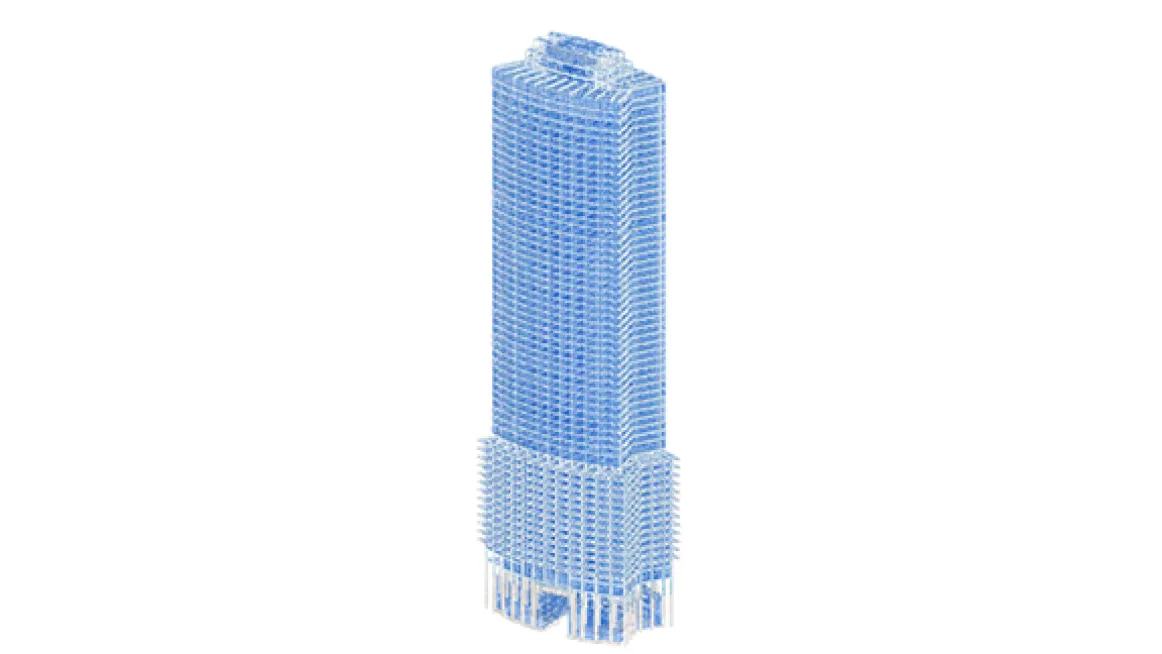
Pythagore, the structural analysis software developed by setec tpi
Pythagore is a finite element structural analysis software package developed by setec tpi over the past forty years. Designed by engineers, for engineers, it is used across all complex civil engineering projects undertaken by setec tpi.
Whether for engineering structures, underground works or high-rise structures, its advanced features, flexibility and adaptability ensure the technical excellence of the solutions designed and verified by our teams.
In particular, it incorporates advanced features such as phased analysis, prestressing, delayed effects in concrete (creep, shrinkage), large-displacement analysis and non-linear analysis of reinforced and prestressed concrete structures. It also enables the modelling of soil-structure and track-structure interaction using non-linear connections, the calculation of live loads, fire analysis, and dynamic analysis (wind, seismic, vibrations), amongst other features…
Find out more
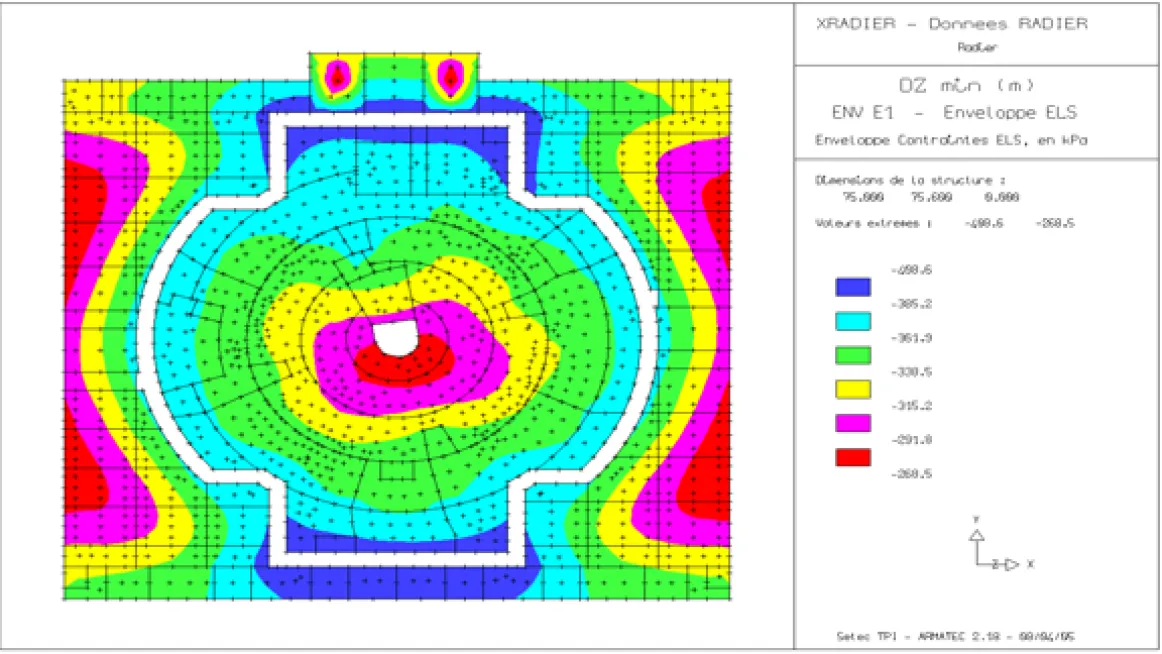
ARMATEC, our solution for analysing and optimising concrete structures
The ARMATEC programme was originally developed by setec tpi as part of the detailed design work for the Monaco sea wall (1999).
It is used for post-processing finite element analyses (carried out in Ansys, Pythagore, Aster or any other equivalent software) and enables the analysis and optimisation of reinforced or prestressed concrete structures, modelled using shell elements (walls, slabs).
The key features of the Armatec programme are as follows:
- Combinations and envelopes (including spectral analysis or wave effects).
- Verification and determination of ELS and ELU reinforcement.
- Reinforcement in any orientation.
- Accounting for over-stresses in prestressing tendons.
- Smoothing and offsetting of reinforcement.
- Calculation of crack opening in accordance with various regulations.
- Verification of cross-sections for shear forces.
- Advanced graphical representation of calculation results in the form of colour-coded maps.
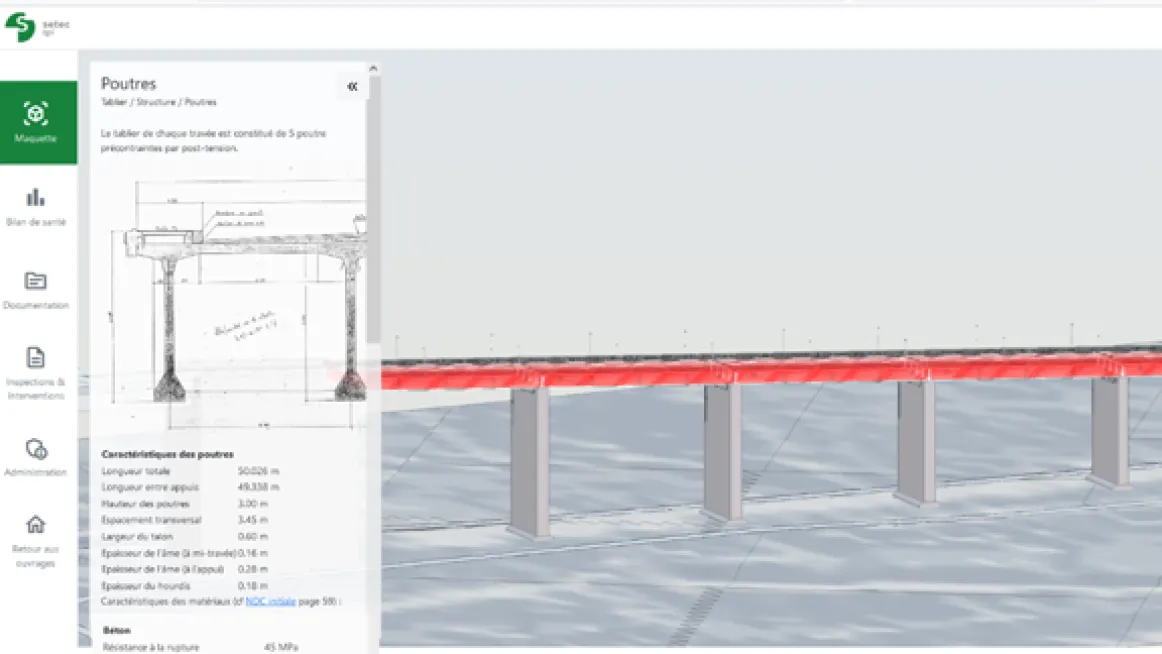
Stwin: data structured around the model
Bridges, as key infrastructure assets with a lifespan that can exceed a century, require ongoing maintenance to ensure their safety and performance. To support managers in this task, setec tpi has developed Stwin, a web platform that centralises all data relating to a structure: original drawings, calculation notes and maintenance records.
Navigation is based on a 3D model, allowing information to be aggregated and visualised intuitively. Each element of the structure provides access to its key data: inspection reports, technical documents and historical records. This approach facilitates understanding, decision-making and communication between stakeholders.
A structured document repository complements the platform, with a configurable classification system (notably in accordance with ITSEOA) ensuring the long-term preservation and integrity of the data.
Finally, Stwin incorporates detailed access rights management, enabling information to be shared securely and tailored to the needs of the various stakeholders.
Chat-Decoda: AI for computation and modelling
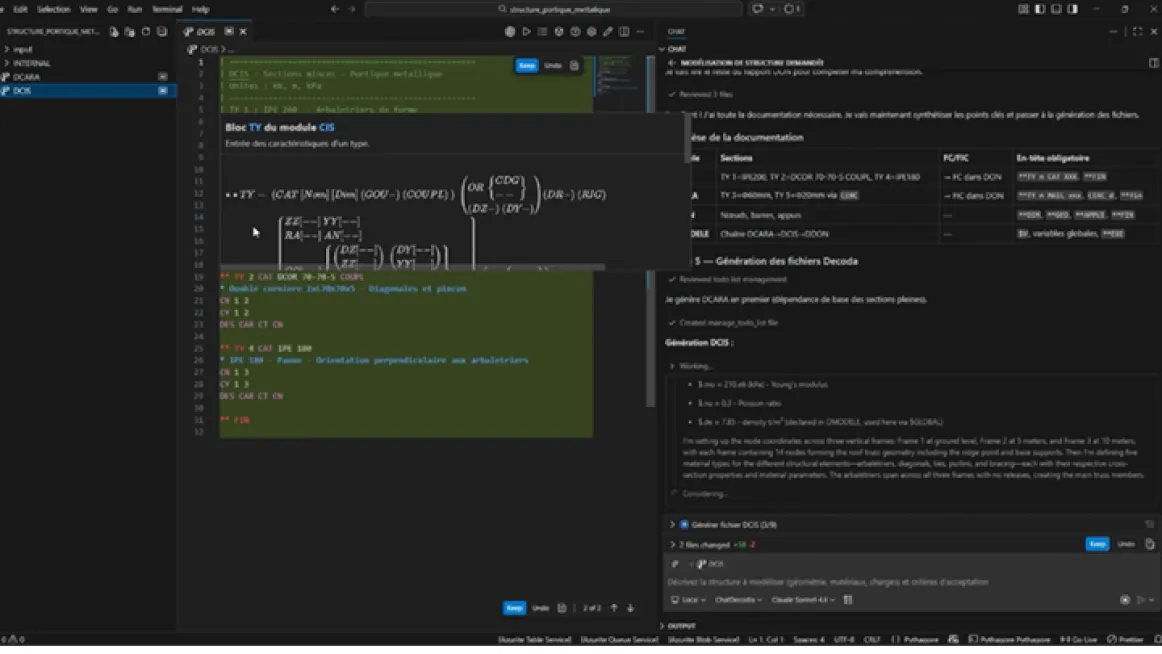
Chat-Decoda was born from a simple idea: recent language models excel at generating code (Python, C++). Why not apply them to DECODA, the data input language used by Pythagore and Armatec?
Chat-Decoda thus offers Pythagore users a modelling assistant that allows them to consult documentation, comment on, modify or generate finite element models.
The approach relies on providing context to the AI model, equipping it with the resources needed to produce relevant DECODA code. This knowledge is drawn both from the model’s initial training and from internal databases: up-to-date user documentation, a library of representative models, and a dynamic database of errors and best practices.
Integrated into VS Code Copilot, Chat-Decoda enables direct interaction with files and tools. The document database, which is vectorised, is accessible via dedicated tools that allow the model to utilise this information effectively.
Pythagiec: designing optimised, low-carbon structures
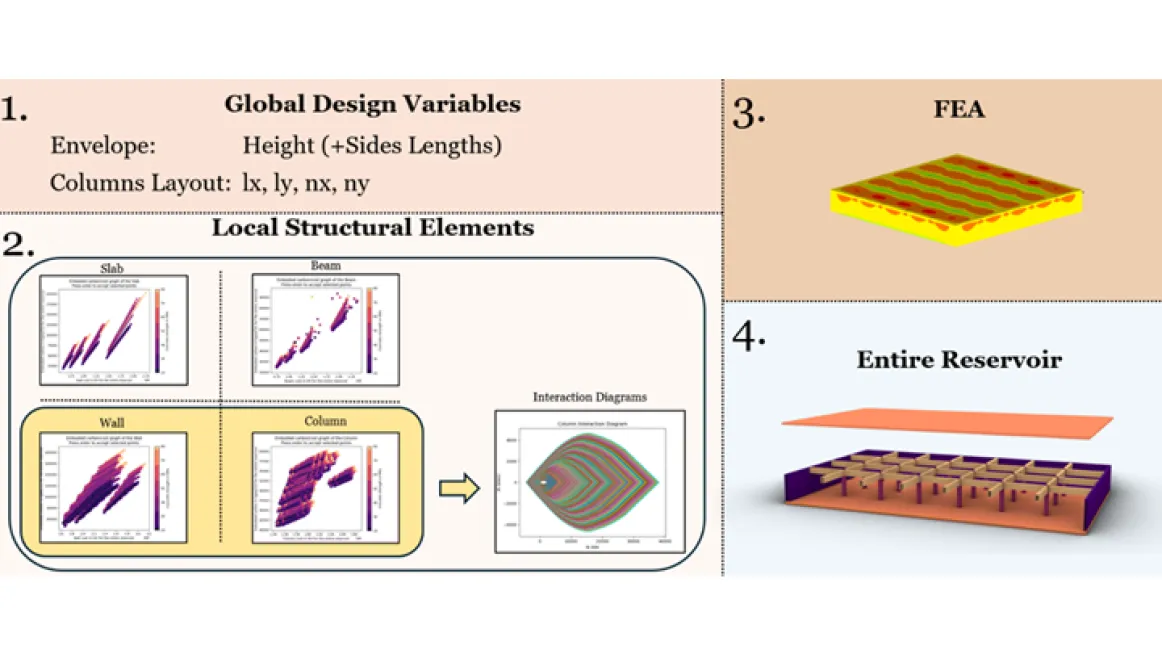
As part of an effort to reduce the environmental footprint of structures, setec tpi is developing optimisation methods aimed at reducing structural carbon emissions. Several approaches have been explored.
Parametric optimisation was first applied to high-rise buildings, generating numerous design variants to identify optimal solutions based on a cost-carbon trade-off. However, this method is only used at an advanced stage of the design process.
Lagrangian optimisation was then used to improve the design of reinforced concrete elements by incorporating construction constraints, with a limited number of iterations.
Generative methods have also been developed to optimise the shape of regular structures, by rapidly exploring numerous variants without resorting to computationally intensive calculations.
Finally, recent work has drawn on artificial intelligence to predict the behaviour of structures and simultaneously optimise their geometry and dimensioning, notably through neural network models.
Business web applications: simplifying the deployment and use of tools
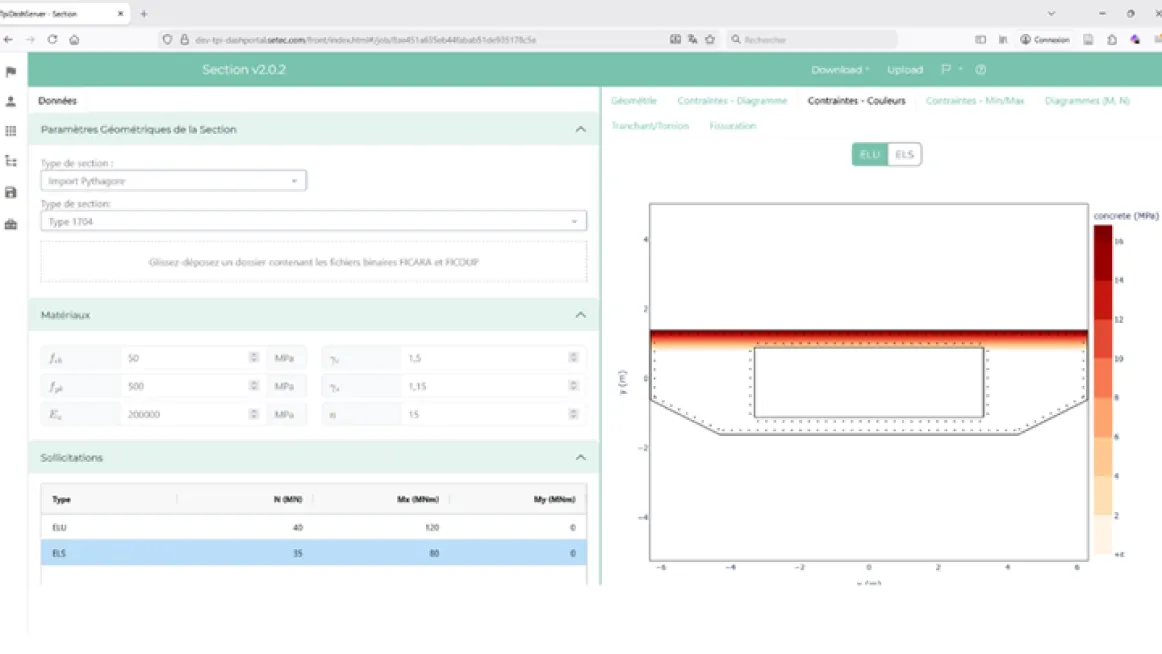
The project aims to facilitate the deployment, sharing and maintenance of business tools within operational teams. It is structured around several complementary developments:
- a web portal for distributing applications, both internally and externally, incorporating authentication, user management and data backup;
- an in-house developed wrapper, based on a Python library, to standardise and accelerate application development;
- the development of the business web applications themselves, tailored to the teams’ needs.