en

Scientific computing
In-house tools designed to enhance performance and accuracy
Our current work forms part of a long tradition of research and development on which setec tpi has relied since its inception. From punch cards to GPU-based calculations, setec tpi has kept pace with and integrated the technological advances that have gradually digitised our fields of expertise.
Our in-house calculation software, a legacy of generations of passionate engineers, is still actively used, maintained and developed. It is constantly evolving to respond to changes in the profession — new materials, repair techniques, complex geometries — as well as to advances in computational capabilities and the regulatory framework.
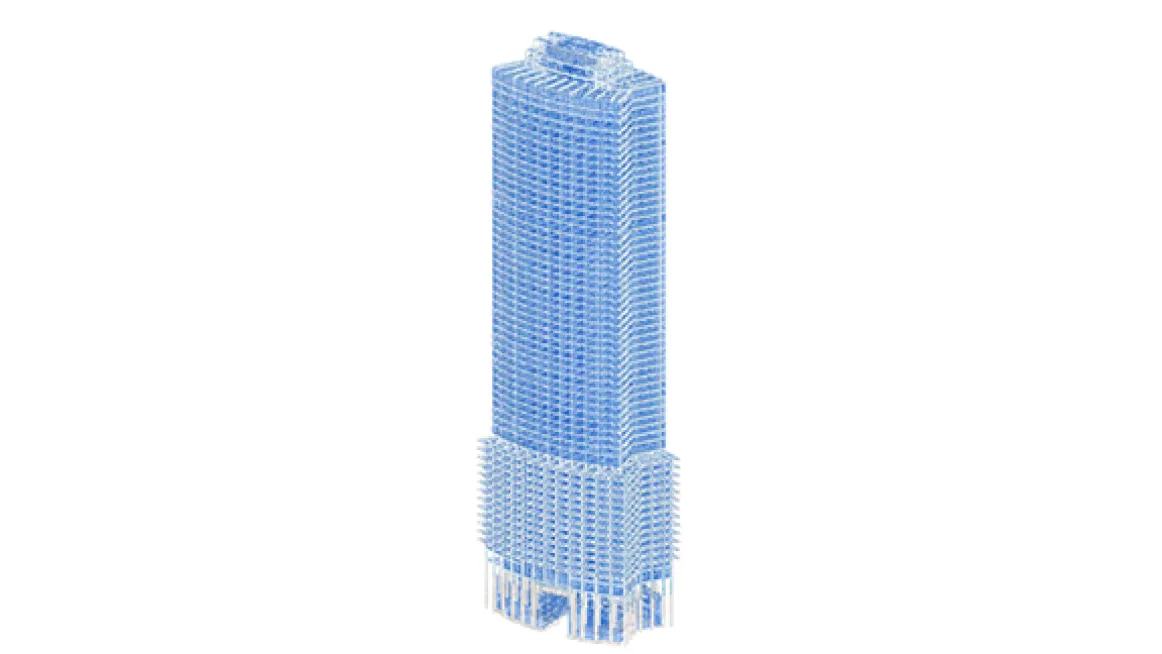
Pythagore, the structural analysis software developed by setec tpi
Pythagore is a finite element structural analysis software package developed by setec tpi over the past forty years. Designed by engineers, for engineers, it is used across all complex civil engineering projects undertaken by setec tpi.
Whether for engineering structures, underground works or high-rise structures, its advanced features, flexibility and adaptability ensure the technical excellence of the solutions designed and verified by our teams.
In particular, it incorporates advanced features such as phased analysis, prestressing, delayed effects in concrete (creep, shrinkage), large-displacement analysis and non-linear analyses of reinforced and prestressed concrete structures. It also enables the modelling of soil-structure and track-structure interaction using non-linear connections, the calculation of live loads, fire analysis, and dynamic analysis (wind, seismic, vibrations), amongst other features…
Find out more
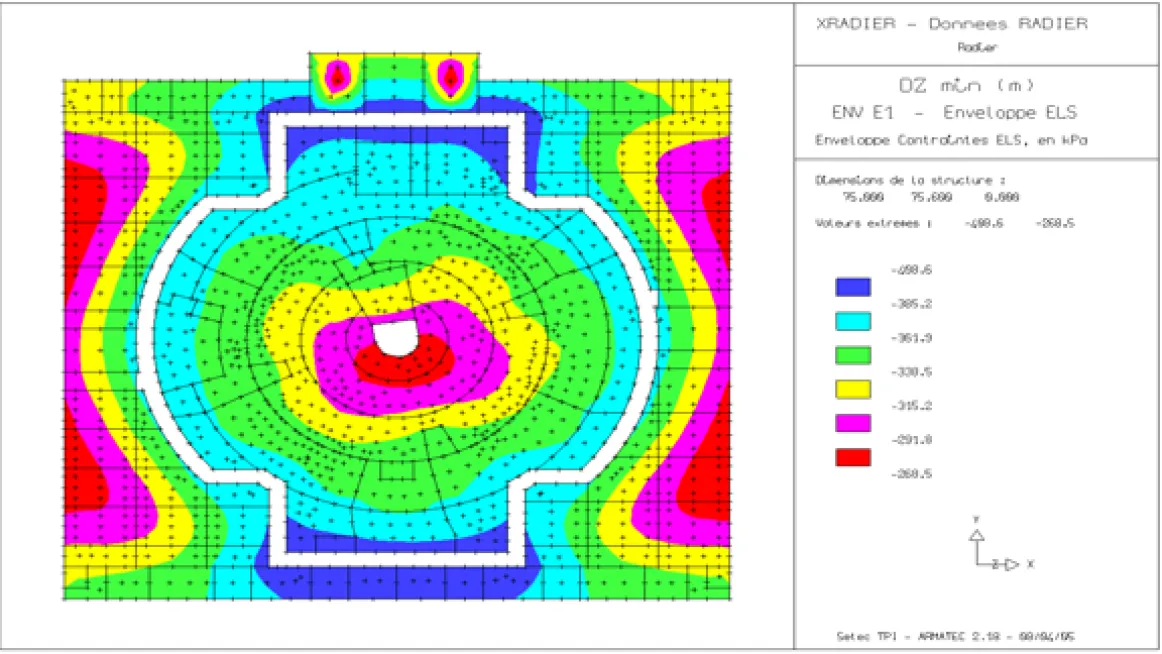
ARMATEC, our solution for analysing and optimising concrete structures
The ARMATEC programme was originally developed by setec tpi as part of the detailed design work for the Monaco sea wall (1999).
It is used for post-processing finite element analyses (carried out in Ansys, Pythagore, Aster or any other equivalent software) and enables the analysis and optimisation of reinforced or prestressed concrete structures, modelled using shell elements (walls, slabs).
The key features of the Armatec programme are as follows:
- Combinations and envelopes (including spectral analysis or wave effects).
- Verification and determination of ELS and ELU reinforcement.
- Reinforcement in any orientation.
- Accounting for over-stresses in prestressing tendons.
- Smoothing and offsetting of reinforcement.
- Calculation of crack opening in accordance with various regulations.
- Verification of cross-sections for shear forces.
- Advanced graphical representation of calculation results in the form of colour-coded maps.
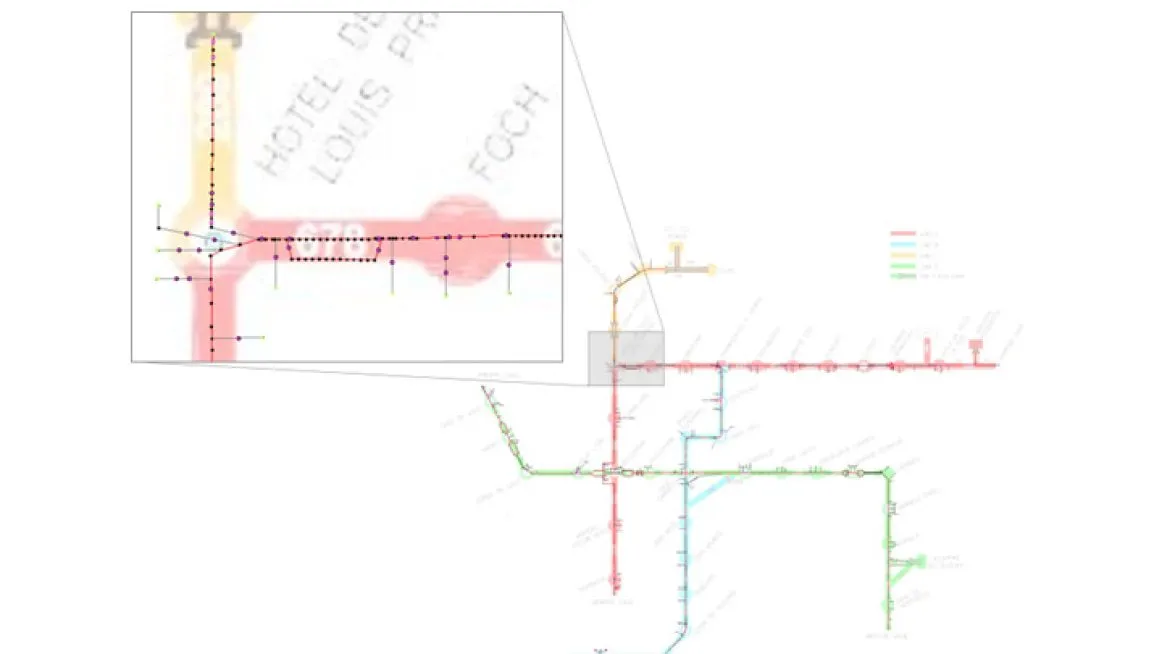
Express’Air: advanced tunnel ventilation simulation
Express’Air is a software programme for simulating ventilation in tunnels, developed by setec since the 1980s and based on the one-dimensional theory of compressible flows in transient conditions, using a meshed network.
It enables the modelling of air flows within a network of tunnels, taking into account various elements such as access ramps, ventilation ducts, smoke extraction hatches, etc.
Thanks to Express’Air, it is possible to design and manage ventilation systems to ensure air quality, smoke extraction in the event of a fire and eardrum comfort where applicable.
The key features of Express’Air are as follows:
- The ability to model all the pipes, branch ducts and ducts in the structure, with no restrictions on length or branching
- Assessment of thermal and aerodynamic parameters at all points in the network (velocity, pressure, temperature, pollution, opacity, humidity)
- Calculations for both steady-state and transient conditions
- Simulation and combination of multiple scenarios, whether for domestic ventilation or smoke extraction, aeraulic verification or tympanic comfort calculations
- Accounting for a wide range of factors to ensure the most accurate representation of the situations under consideration:
- Natural ventilation and the chimney effect
- The specific characteristics of each type of tunnel (road tunnel, rail tunnel, canal tunnel, service gallery)
- Transient control of equipment (fans, accelerators, injectors, hatches, barriers, etc.)
- Variations in traffic scenarios and external conditions
- Pollutant emissions from different types of vehicles
- Heat and smoke emissions caused by a fire (stationary or moving)
- Heat exchange with the tunnel lining and the rock
- Calculations of pressure waves, taking into account the inertia of air and its compressibility
- Calculations of eardrum comfort, taking into account the airtightness of trains
- Simulation of PID control for both ventilation and smoke extraction systems, enabling the refinement of PID coefficients, optimisation of system responsiveness and the number of units required, and a reduction in overall energy consumption
- Ability to automate calculations and perform sensitivity analyses
- Ability to perform multi-objective optimisation to optimise the overall design of a system or to automatically calibrate a model based on experimental measurements.